Wooden or Plastic Chopping Boards: What Changes in Care?
Wooden or plastic chopping boards need different everyday care. Learn how to clean, dry, store and assess each type without treating one as best.
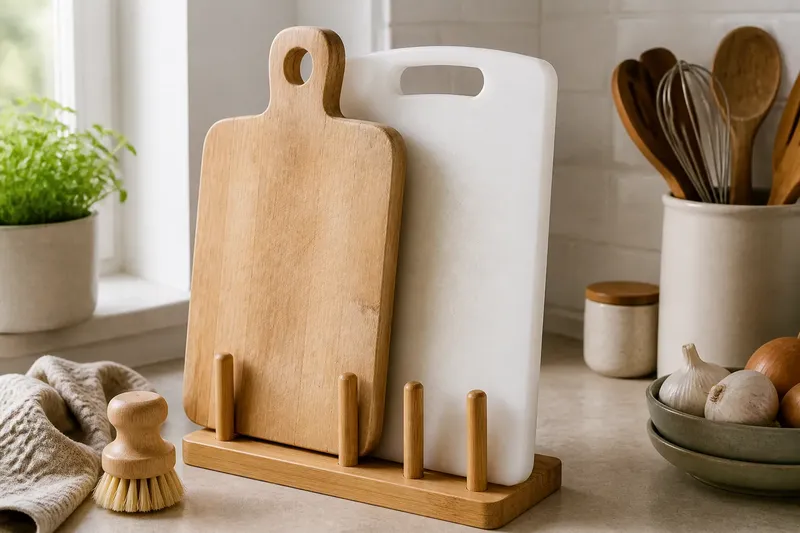
Wooden or plastic chopping boards respond differently to water, knife marks and drying, so the best care depends on the board in front of you. Wood needs careful drying and occasional conditioning; plastic usually asks for closer attention to grooves and any care limits on its label. Neither material is automatically the right choice for every kitchen.
Use these differences to shape a simple routine, rather than treating board care as a contest between materials. For food-safety decisions, follow the board maker’s instructions and local food guidance; replace or retire a board when its condition makes thorough cleaning difficult.
1. Start with the surface
Wood is a natural material, and its surface can absorb moisture if it stays wet or is repeatedly soaked. Many wooden boards are made from hardwood, but construction and finish vary: an end-grain board, an edge-grain board and a board with a surface coating may need different handling. Check whether the maker calls for a particular oil or prohibits certain cleaners.
Plastic boards are commonly made from materials such as polyethylene or polypropylene. Their non-porous surface does not require oiling, but cutting can leave grooves and raised edges. Those marks become the practical focus of care: food residue can cling in damaged areas, and cleaning becomes harder as the surface deteriorates.
Before setting up a routine, look at the board’s material, finish and condition. A thin plastic board and a thick wooden butcher’s block do not dry or store in the same way, even if both are used for the same task.
2. Clean straight after use
For either material, scrape off food promptly and wash with warm water and washing-up liquid. Use a clean sponge or brush, paying attention to knife grooves, edges and the area around a handle or juice channel. Rinse away detergent and food residue rather than leaving the board to sit in the sink.
Wood benefits from a brief wash, not a soak. Avoid leaving it submerged, putting it in a dishwasher, or allowing water to pool on it; prolonged wetting can contribute to swelling, warping or cracks. Wipe both faces so that one side is not left damp against the worktop.
Plastic boards may tolerate a dishwasher, but do not assume that every board can go in one. Check the manufacturer’s care label, especially if the board is thin, has a non-slip edge or includes joined parts. If hand-washing, scrub the whole surface and both sides rather than treating only the visible cutting area.
3. Dry without trapping moisture
Drying is where the daily routines diverge most. Stand a wooden board on its edge or place it upright in a rack so air can reach both faces. Do not lean a wet board flat against a wall or leave it lying on a damp cloth; trapped moisture can leave one side wetter than the other.
Plastic also needs to dry fully before it is put away, especially around textured surfaces, handles and raised rims. It is generally less sensitive to brief wetting than wood, but storing any board while damp can leave stale odours or encourage residue to remain in crevices. Make sure the rack or cupboard is clean as well.
Say you have washed a wooden board after chopping vegetables and need the worktop back. Stand it upright in a dish rack, with space around both faces, and return it to the cupboard only when dry; the observable result is a board that is not stored with one damp side pressed against another surface.
4. Manage knife marks
Knife marks are normal signs of use, but their depth and roughness matter more than their mere presence. Run your eyes and fingertips over the board after washing. If the surface has deep cuts that hold visible residue, splinters, cracks or areas that no longer clean readily, set it aside and consider resurfacing or replacement rather than relying on repeated scrubbing.
Wood may sometimes be lightly sanded and refinished if the maker allows it and the board remains sound. Sanding is not suitable for every finish or construction, and it can change the surface or expose layers. If the board is bonded, coated or damaged through its thickness, consult the maker’s instructions instead of improvising a repair.
Plastic boards can also be worn down, but grooves tend to accumulate across the cutting surface. Do not use a rough abrasive simply to make the board look new: it may leave additional scratches. If the cuts are widespread or difficult to clean, replacing the board is often the more straightforward option.
5. Condition wood selectively
A wooden board may benefit from food-contact mineral oil or a board conditioner intended for kitchen use. Apply only a product the maker permits, following its directions; household cooking oils can become rancid and are not a universal substitute. Conditioning is maintenance for the surface, not a way to close cracks or repair structural damage.
There is no need to oil plastic. Instead, keep its surface clean and inspect it as it wears. Applying oil or a furniture polish to plastic can leave a residue without addressing knife grooves, so use products only for their stated purpose.
When a wooden board starts to look dry or feels rough, first wash and dry it thoroughly, then assess whether the maker recommends conditioning. If it has a crack, persistent odour or a finish that is peeling, oil alone is not a remedy; decide whether it can be safely restored or should be retired.
6. Store by shape and use
Give each board a stable, dry place where air can circulate. Wooden boards are usually best stored upright or on a rack once fully dry. Avoid wedging them tightly beside a damp sink or placing heavy cookware on top, since pressure and uneven moisture can encourage warping.
Plastic boards are often lighter and easier to fit into a rack, but do not force a bent board flat into a crowded cupboard. Keep it away from sources of heat that could distort it, and avoid stacking wet boards together. If you use separate boards for different foods, store them so you can identify the intended board before preparing a meal.
A small rack or a clear slot in a cupboard can make the difference between a board that dries properly and one that is put away too soon. Choose storage based on the board’s size and shape, not simply its material.
7. Choose a board for the task
Consider how you cook and clean. A wooden board may suit someone who wants a substantial surface and is willing to wash it by hand, dry it upright and maintain its finish. A plastic board may suit someone who prefers a lighter board or has a model whose instructions permit dishwasher cleaning.
Neither choice removes the need to inspect the surface. If you prepare different kinds of food, separate boards can help keep tasks distinct; label or colour-code them if that makes the routine easier to follow. A board that is easy for you to wash, dry and store is more useful than one chosen for a material’s reputation alone.
Think about the whole care routine before buying another board: where it will dry, how it will be cleaned and how you will recognise wear. The answer to “wooden or plastic chopping boards?” is less about picking a winner than matching the material to your kitchen habits and keeping the surface in cleanable condition.
Questions about board care?
Can wooden chopping boards go in the dishwasher?
Usually, no: prolonged heat and moisture can damage wood. Follow the board maker’s directions, and hand-wash and dry it promptly if dishwasher use is not explicitly allowed.
Can plastic chopping boards go in the dishwasher?
Some can, but the answer depends on the board’s material and construction. Check its label or manufacturer’s instructions before using a dishwasher, and hand-wash it if that guidance is unavailable.
How often should a wooden board be oiled?
There is no single schedule for every board. Use the maker’s guidance and the board’s condition to decide whether it needs a suitable food-contact conditioner; do not use oil to disguise cracks or deep damage.
When should I replace a chopping board?
Consider retiring a board when deep grooves, cracks, splinters or persistent residue make it difficult to clean properly. A sound wooden board may be repairable if its maker permits resurfacing, while a heavily scored plastic board may be simpler to replace.